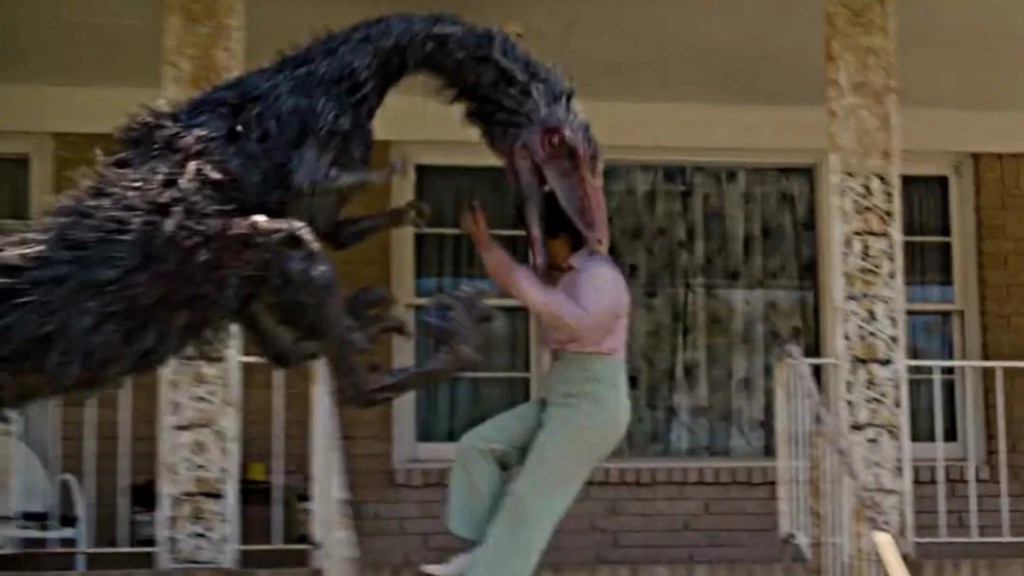
The End of Oak Street is Hollywood’s latest dinosaur flick. In many ways the movie is a cliche, from its Spielbergian 80’s suburb to the underlying family drama as sharp-toothed prehistoric nasties prey on the beloved pet dog. That said, there is one way in which the movie stands out and that is in its depiction of feathered dinosaurs. For decades now, cinematic representations of dinosaurs have largely been stuck in the past. Since the early 90s, palaeontologists have known that many dinosaurs were far closer to birds than giant reptilian monsters, yet, outside of a few scientific documentaries, blockbuster cinema has been remarkably slow to embrace feathered dinosaurs.
This was something I actually explored for a section of my undergraduate History dissertation. Entitled ‘The History of the “Dinosaur” in Modern Britain‘, my thesis looked at how dinosaurs have never simply been scientific discoveries in the public imagination; rather, they are cultural creations shaped by the people and industries presenting them. Throughout time, dinosaurs have repeatedly been used for “profit, propaganda and prestige”, with their public image changing depending on the motivations of those bringing them to audiences.
When researching the final chapter of my dissertation, I was keen to understand why scientifically accurate feathered dinosaurs had struggled to appear in major blockbuster films. When the original Jurassic Park was released in 1993, the film was relatively up to date with contemporary palaeontological understanding, even if it took some creative liberties with certain species. In one of the film’s earliest scenes, Dr Alan Grant uses an image of a fossil raptor to explain how ‘maybe dinosaurs have more in common with present-day birds than with reptiles’.
Tragically, later instalments in the franchise proved less successful at keeping up with the latest scientific findings. In 1995, two years after Jurassic Park was released, a Chinese farmer discovered Sinosauropteryx, the first dinosaur fossil to be found with feathers. Palaeontologist Matthew Lamaanna described the discovery as ‘one of those rare moments in science where the answer is so clear it’s like getting hit over the head with a two-by-four’. The find forced the last of the hardline objectors to accept the dinosaur-bird connection. Yet, despite the irrefutable evidence, Jurassic Park: Lost World (1997) retained the dinosaur designs of the original feature, failing to update the appearance of the dinosaurs in light of the revolutionary Sinosauropteryx specimen. The third film (2001) was hardly better, adding ‘little feathery wisps [to the head of] otherwise bald [velociraptors]’ in what a writer for National Geographic described as ‘the barest token [of an] effort’.
Ultimately, there are two key reasons for the slow transition to feathered dinosaurs. First, technological limitations made the depiction of feathers far more difficult than traditional reptilian designs. Science advisor to the Jurassic Park franchise Jack Horner has discussed how there were technical problems with creating convincing feathers using computer graphics at the time. Although the scientific evidence for feathered dinosaurs was emerging, the technology required to bring them convincingly to life on screen was still in its infancy. Secondly, Hollywood had made a fortune depicting dinosaurs as scaled prehistoric monsters, meaning changing their appearance represented an unnecessary commercial risk. By retaining the familiar designs established by Jurassic Park, studios could continue to benefit from audience nostalgia and the recognisable image of the franchise. As my dissertation argued, commercial interests encouraged the continued portrayal of scaled reptilian dinosaurs, even as the fossil record increasingly revealed a more complex picture.
Despite the scientific inaccuracy of scaled dinosaurs in the Jurassic Park franchise, the science populariser and palaeontologist Steve Brusatte described the franchise’s first film as ‘the best thing that’s ever happened to dinosaur palaeontology’. The movies have directly funded projects in dinosaur research, created numerous jobs in the field of palaeontology and inspired a whole generation of children to get into dinosaurs. Consequently, he argues the paleontological inaccuracies in films like 2015’s Jurassic World ought to be forgiven as the feature will ‘get people talking about dinosaurs, thinking, reading, doing web searches about them, asking their teachers, going to see them in museums’. Scientists themselves have even utilised the media buzz surrounding dinosaur blockbusters to further their own research. For instance, Nature magazine seemed to have intentionally held the publication of an article on the DNA sequencing of a 125-130 million-year-old amber preserved weevil in order to coincide with the premiere of Jurassic Park in 1993, timing the release of the scientific paper in order to capitalise on associated media attention. For Brusatte, the scaled dinosaur of cinema was not an enemy of the scientifically accurate feathered dinosaur, but rather the reason so many people became fascinated by prehistoric life in the first place.
Eventually, feathered dinosaurs began appearing in Hollywood blockbusters, most notably with the release of Jurassic World Dominion in 2022. By this time, Steve Brusatte was actually working as a science consultant for the franchise, and I couldn’t help but notice how the movie’s ending perfectly embodied his belief that, however inaccurate, the cinematic depiction of dinosaurs was not an enemy of the real science. In the film’s final climactic battle, the old scaled T-Rex from the first movie battled alongside a feathered Therizinosaurus to defeat the threatening Giganotosaurus. Rather than presenting the traditional cinematic dinosaur as an outdated relic that needed to be discarded, the scene could be read metaphorically as popular culture and modern palaeontology existing and working alongside one another for mutual benefit. The same reptilian monsters that captured audiences’ imaginations for decades had created the fascination that allowed people to embrace a more scientifically accurate vision of prehistoric life.
In many ways, The End of Oak Street represents the next step in the evolution of cinematic dinosaurs. Chock full of feathered dinosaurs, the 2026 blockbuster demonstrates how advances in technology, combined with audiences now being accustomed to the idea of bird-like dinosaurs, have finally allowed Hollywood to embrace films that reflect our modern understanding of these extinct creatures. Here’s hoping to see more feathered dinosaur films in the future.


Leave a Reply