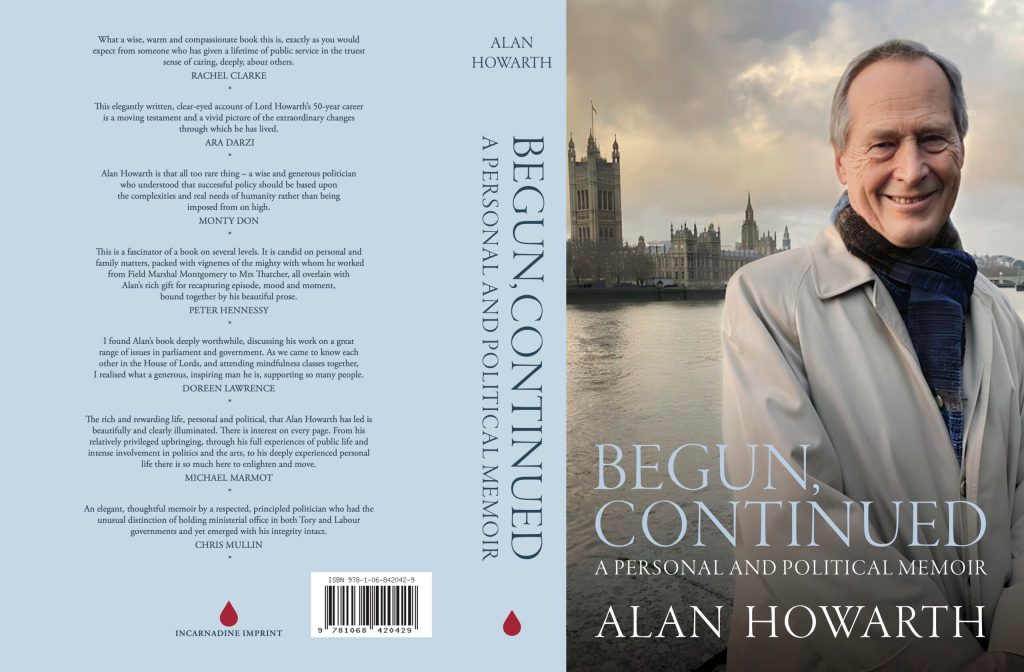
In studying for a PhD, you explore all sorts of fascinating avenues for research that only later you conclude have little relevance to your final thesis. This proved precisely the case when reading Alan Howarth’s Begun, Continued, a wonderful autobiography detailing the life of the first sitting Conservative MP to switch to the Labour Party. While the book is chock full of details that will doubtless prove invaluable when examining the disaffected Conservative MPs of John Major, there were large chapters on his childhood and early career that I diligently worked through only to conclude that, however interesting in themselves, they offered little of direct relevance to the questions at the heart of my research.
Still, there was one thing that stood out to me in those early chapters that I continue to think about. One of Howarth’s first jobs upon graduating from Cambridge was as a ghostwriter / researcher for Field Marshal Bernard Montgomery’s book, A History of Warfare (1968). A family friend to Britain’s most-esteemed World War II General, perhaps I shouldn’t have been surprised to read how caring Montgomery was in his correspondence to Howarth. Yet there was something strangely striking in the affection shown. Take this charming reply Montgomery wrote to Howarth back when he was just a school student:
I have just returned from six weeks in Switzerland and was delighted to hear from you. I regard you as one of my young friends and the fact that you wrote to me shows you want to be regarded so.
Or the concern expressed for Howarth’s well-being once he began work on the book.
My main pre-occupation (apart from the book) is to ensure that when our task is complete you and Anthony are put securely on the way to higher things, and that occupies my thoughts daily – and will continue to do so, come what may.
Evocative quotations such as these, alongside Howarth’s description of him as an evidently deeply caring boss, reveal how emotionally rich cross-generational male friendship could be, even within a culture we often remember chiefly for its reserve.
Ultimately, I think the Field Marshall’s letters seem remarkable because of the misleadingly narrow conception of masculinity that we tend to impose retrospectively upon men of his generation. Though there is no doubt a degree of truth to the stereotype of the stiff British upper lip, the letters rub against a simplified narrative of male emotional repression. It says something that the men of that era could be expressive and tender in private correspondence. In an age of texting and overly simplistic conceptions of masculinity, these letters are a reminder that tenderness between men is neither especially modern nor historically anomalous. If a man such as Bernard Montgomery, who occupied about as conventionally macho a role as one could imagine, was capable of expressing warmth and affection so freely in letters, then perhaps there is something to be said for resisting the instinct to edit warmth out of a text. A little sincerity, even at the risk of sounding cringeworthy, is probably no bad thing.


Leave a Reply