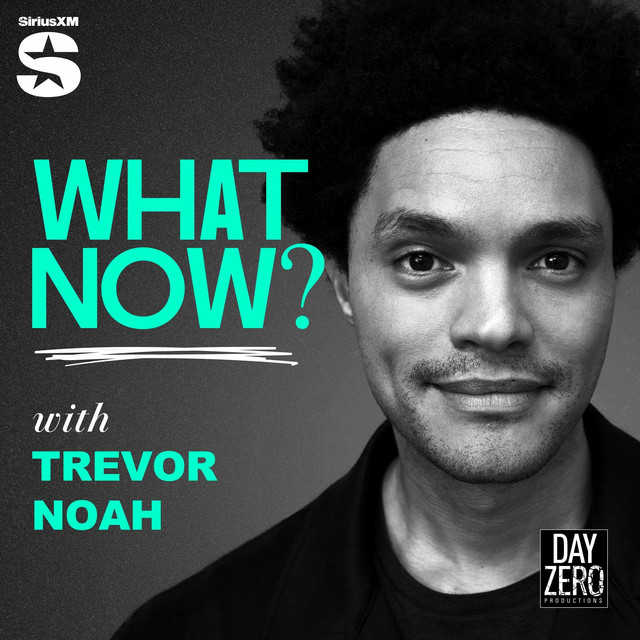
If you’d asked me a year ago I would have been confident in my conviction that the world doesn’t need more celebrity podcasts. Don’t get me wrong, I enjoy seeing social media clips from Amy Poehler’s Good Hang as much as the next person, but in an industry that once promised a widening horizon of radio voices and talented up-and-comers, I can’t help but feel that the scrappy podcasting magic I fell in love with has been increasingly eclipsed by star power. Now every celebrity has a podcast and if they aren’t rewatching their old work they’re conducting chummy interviews with other famous friends in studios that look more like TV studios than someone’s spare bedroom. Given that the genre of celeb-hosted interview podcasts is so incredibly overdone, I was surprised to find What Now? with Trevor Noah might be my favourite podcast of 2026 so far.
I first gave the show a try when I heard it was being produced by Jody Avirgan’s production company, Day Zero Productions. As a fan of Avirgan’s since his days hosting the FiveThirtyEight Politics podcast and later as an enjoyer of his history podcast This Day, I felt cautiously optimistic that this wouldn’t just be another celebrity vanity project. At that time I knew very little of Trevor Noah. As a Brit, I think I was semi-aware he once hosted a political late-night show but I couldn’t have told you what the programme was called or really anything more than that. I went in expecting a well-produced, perfectly pleasant celebrity podcast—the kind you listen to on a walk and forget by dinner. Something competent, maybe even occasionally insightful, but ultimately indistinguishable from the many others already crowding the charts.
I profoundly underestimated it.
Trevor Noah is deeply insightful. In some sense this shouldn’t have been surprising to me. To be professionally funny I think you have to be observant. He’s hyper-attuned to social dynamics, to the mechanics of power, and to the absurd logic that props up so much of modern life. While these skills make for a great comedian, they are also the skills that make someone a great interviewer.
His guests frequently remark on the quality of his questions. Author of the book Inheritocracy, Dr Eliza Filby described Noah as ‘one of the most intellectually agile people I have ever spoken to, the kind of clever that disarms you because it is carried with humour rather than ego’. Another guest was so taken aback by the insightful nature of one of Noah’s questions his immediate response was to say “You should just run [for office]”.
In a recent episode, video journalist Cleo Abrams appeared visibly taken aback to realise Noah had actually watched her work. “Oh, you’ve really watched the show! This is awesome!” she exclaimed. Noah replied, “Why would I invite you here if I hadn’t watched the show?”, almost unaware of how frequently podcast guests can be booked without much thought. He didn’t simply assure her he’s familiar with her videos; he referenced specific episodes — the Hadron Collider, quantum computing, the scale of asteroids — recalling not just the topics but the jokes she used to make them land. “You teach well,” he told her, before unpacking why he thinks her humour works so effectively as an explanatory tool.
Noah seems to purposefully go out of his way to book guests that have truly impacted his thinking on the world. In May 2025, he released an interview with Christian Rudder, co-founder of Ok Cupid and author of the book Dataclysm. Rudder commented on being invited on the show, saying “At first I was like, is this a scam? I’m going to get mugged if I show up to this thing. Like, why […]. It has been a while since I’ve done, like, any media… it was just very, extremely flattering”. It’s not hard to see why he was surprised. Rudder isn’t promoting a blockbuster film or a buzzy memoir; he’s a data analyst whose most provocative work was published nearly a decade ago. Noah’s system for booking guest doesn’t revolve around the tedious PR cycles to the same extent as other celebrity podcasts. Instead he appears to book guests he owns an intellectual debt – people whose work has quietly informed his worldview and sharpened his thinking. It doesn’t matter if they have nothing to promote. If he’s still wrestling with an idea they introduced him to, he wants them in that podcast studio.
A final factor that has made listening to What Now? a somewhat profound experience for me is Noah’s ethnicity and background growing up in South Africa. At my current life stage, I’m blessed to have a fairly multicultural friendship group. I have several British-Korean friends. Through my work with an international student charity I became very close to several Chinese students. Considering how little of the world I’ve truly explored, I’d like to think I’m decently culturally aware. That said, I’m conscious that my social world hasn’t included many close Black friendships, and I certainly haven’t often found myself in spaces where Black perspectives shaped the centre of the conversation. That’s part of why What Now? has felt so valuable: it regularly brings me into discussions and perspectives I wouldn’t otherwise encounter day-to-day. Noah and his co-hosts — like Josh, Christiana and Eugene — foreground voices and cultural experiences that sit outside the white-majority spaces I move in, giving attention to ideas and conversations that wouldn’t typically be part of my lived experience.
So that’s Part 1 of why I’ve unexpectedly fallen in love with the podcast What Now? with Trevor Noah. This piece has centred on what has made the podcast feel so profound for me personally — from Noah’s interviewing style to the perspectives I wouldn’t otherwise encounter in my day-to-day life. At some point I’ll write a Part 2 where I’ll explore some of the ideas I’ve taken from the show that have genuinely reshaped the way I see the world, so stay tuned for future blogs on the subject. If you’re like me, you’ll never think about community the same way again.
 Josh Wright
Leave a comment