All things must come to an end, and TV shows are no exception. How a programme ends though remains an open question. Some writers seek to put a bow on their creations in a celebratory finale, bringing the stories of their beloved characters to a definitive close. For other creators, this option is taken out of their hands, the show unceremoniously cancelled in spite of the programmes brilliance. Occasionally, a show reaches its conclusion with no dramatic farewell at all, presenting a closing episode that feels deliberately ordinary. No grand wrap-up. No narrative finality. Just another episode — one that happens to be the show’s last.
The latter seems to have been the case with Yes Prime Minister. Its final episode, The Tangled Web, was charming and humorous as ever, albeit unremarkable in a long line of consistently strong instalments. The story was left open to further continuation: Prime Minister Jim Hacker remained in office, and viewers were free to imagine the political and bureaucratic battles that would continue to unfold between him and Sir Humphrey Appleby. On a personal level, I’ve always liked this style of understated open-ended conclusion. There’s something strangely comforting in the knowledge that the characters we have grown to love continue beyond the frame, their lives and conflicts going on, even if, as viewers, we’re no longer able to follow them.
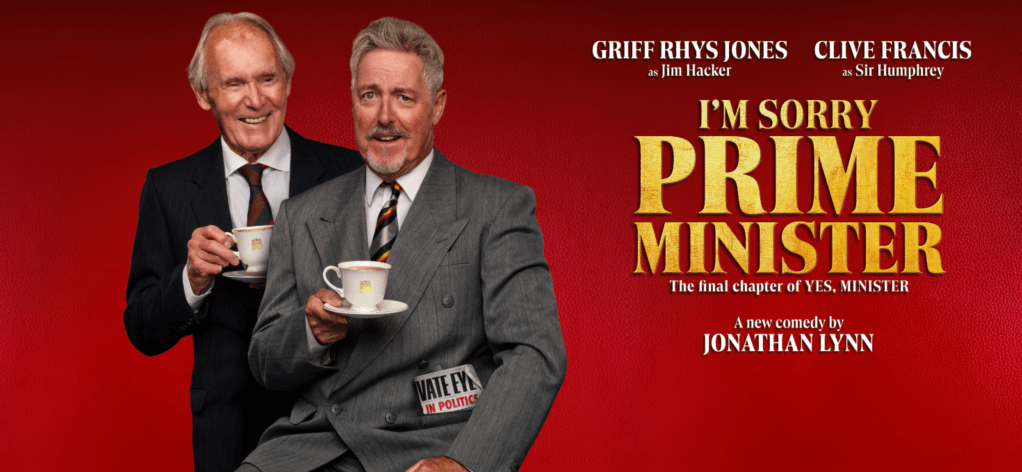
It was consequently brave of Jonathan Lynn to produce a final chapter of the series in the form of a stage play entitled, I’m Sorry Prime Minister. As a late convert to the show, I sadly missed my opportunity to see it being performed in Cirencester back in 2023, so I was excited when I heard news that the play would be coming to the West End in 2026. Would a return to these characters feel like a natural continuation, or an unnecessary addendum to what had been a perfect run? Could new actors convincingly inhabit such well-loved roles? Could the play offer genuine closure, or would it risk shutting doors that had been best left ajar?
I’m delighted to report I found I’m Sorry Prime Minister delivered in every way I could hope for. First, credit to Lynn for finding an inspired way to tell a new and innovative Yes Minister story. Mild Plot Spoilers Ahead: Set in his Oxford College Home, the play follows an elderly post office Jim Hacker hiring a care worker to help take care of his needs. It later transpires that, having made some unwise comments that made their way onto social media, Hacker’s comfortable life as Master of Hacker College is in jeopardy. With few cards left to play, a desperate Hacker calls on an old colleague; someone who knows the machinery of power better than anyone and has got him out of more than a few tight spots in the past.
Following Hacker as an aged and retired Prime Minister was a stroke of genius. First, removing the characters from the Downing Street setting and making them all far older made it easy for a new cast to play the iconic roles. I had no trouble believing Griff Rhys Jones as a much older Jim Hacker. From my seat high in the rafters, he was almost a look a like. The casting of Clive Francis as Sir Humphrey Appleby was less exact in terms of physical resemblance, though he captured the character’s clipped authority, patrician arrogance, and razor-sharp delivery perfectly. Furthermore, shifting the action away from the familiar corridors of Whitehall allowed the play to explore these characters in a different kind of story. The desperate attempts at clinging to power remained, albeit at a different scale. They are no longer at the height of their power, politically or cognitively. In relocating the characters to a new phase of life, the play finds fresh comic territory without sacrificing the rhythms and rivalries that made the original series so enduring.
Ultimately, the play felt like the perfect ending, honouring what came before while knowing better than to rehash past glories. By setting the action decades later, Lynn preserves the original series’ open-ended charm while still allowing the story to move forward. The Hacker–Humphrey relationship remains intact, its familiar mix of rivalry and dependence proving just as funny outside the corridors of power. There is something incredibly heart-warming in seeing them together once more, their long-standing antagonism softened by age into a form of reluctant companionship. I consequently recommend that any fans of the show take the opportunity to experience this final chapter while they can.
 Josh Wright
Leave a comment