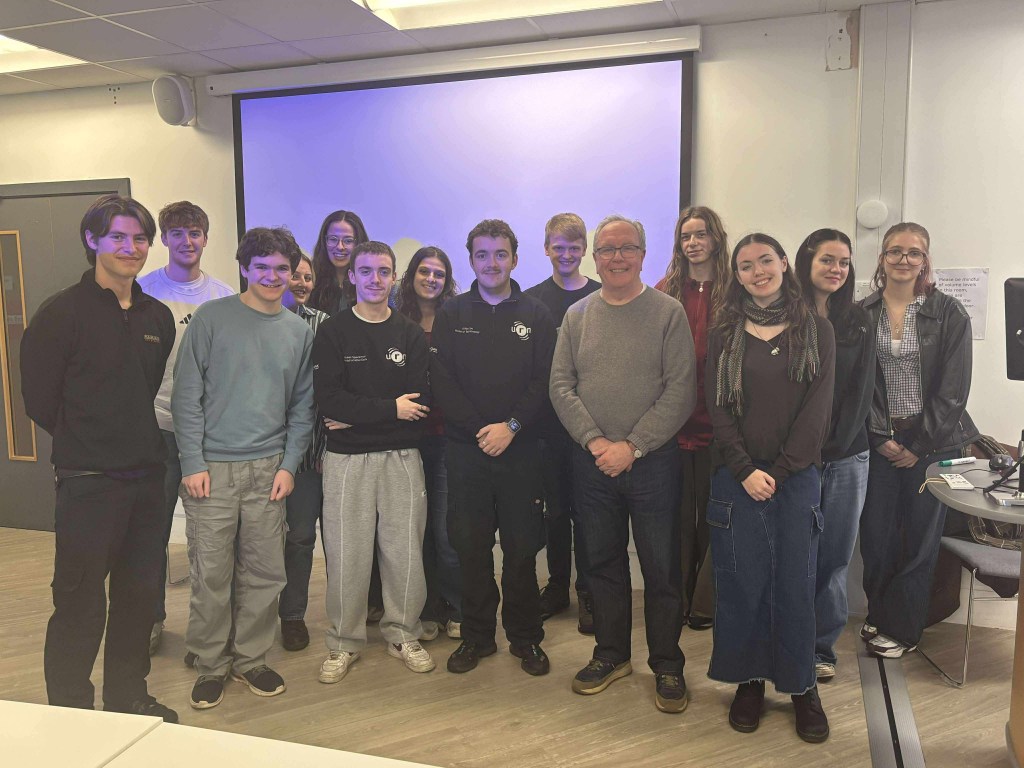
On Monday the 10th of November I had the immense privilege of attending a talk with former BBC executive and host of the award winning Folk on Foot podcast, Mathew Bannister. The event, put on by the University of Nottingham Careers Service in collaboration with the Development, Alumni and Relations Office (DARO) and University Radio Nottingham, was a wonderful opportunity to hear from a highly accomplished name in the radio / podcast sector and to ask him directly about his experience in the industry. I’m excited to offer some of the key points I took away from the talk as well as share some of the answers he generously gave to the handful of questions I was able to ask.
*Important Note: I was too engrossed in Bannister’s talk to make proper notes so I’ve written this article almost entirely from memory. I’ve done my best to be as accurate to my recollections as possible, however if at any point I’ve mischaracterised anything that was said I wholeheartedly apologise.
Folk on Foot is a show in which Bannister takes a leading folk artist out for a walk in the landscape that helped inspire their music. A combination of folk music and riveting interview, the podcast is recorded live on location. Bannister shared with much earned pride a review in The Telegraph that stated how:
“The music is transcendent, the sense of place is transporting… It’s a restorative breathing space in sound.”
The latter portion of the quote beautifully surmised what Bannister was hoping to achieve with the program. That line has since become a sort of lodestar for Bannister and his team — a reminder of the atmosphere that they’re hoping to evoke with each episode they produce.
Bannister was quick to point out at the start of his talk how his show isn’t the kind of format he’d recommend to people new to the podcast creation space due to its expensive production costs. Each episode has travel expenses as well as the costs of paying his recording crew. Though many artists would willingly appear on the show for free, Bannister believes its a point of principle that artists should be compensated for their work and so the Folk on Foot podcast also pays the musicians for their appearances on the show.
When conceiving the show Bannister spent a great deal of time exploring whether his idea for the podcast had legs; researching whether his program would fill an open niche or simply be drowned in a sea of similar competitors. After determining his idea was unique with a clear and identifiable audience, Bannister went about producing some of the first episodes, inviting on some of the folk musicians he most admired as some of his early guests. He jokingly remarked how he thinks he may be partially responsible for getting the over-60s into podcasts, sharing an anecdote about flyering the queue at a Folk music festival where he had to explain the medium to a generation that (at the time) was only really familiar with radio.
Although Folk on Foot is primarily an audio product, Bannister always recognised the importance of having some video to show his audience the amazing locations the musicians were performing their music in. He then showed us a series of promotional videos his podcast produced in order to promote the show (see an example or two below).
It occurred to me as I was watching these that there’s little wonder why Bannister has a big queue of musicians hoping to appear as guests on the program. I can imagine how the short promotional videos that are released for each podcast could be incredibly valuable as a way for a small musician to demonstrate a flavour of their music and talent. I could see the clips being put on artist’s websites or used the way an actor might employ a showreel of their work. For some musicians, the production of these promo videos alone could be enough to make committing to the podcast a worthwhile endeavour.
Listening to Bannister, one could tell how much the project was a labour of love. Without sharing any specific numbers, he was quite candid about the shows financials, admitting that whilst the podcast would never be a big money making venture they had turned it into a sustainable venture through the monthly contributions of Patreon supporters, tips on Ko-fi and a small amount of advertising revenue. Furthermore, I got the impression Bannister’s drive to make the podcast derived not only from a sense of passion, but also out of duty of care to do what he could to help support the folk music scene. During the pandemic, the podcast organised several virtual folk music festivals that were able to raise a cumulative total of over £300,000 to support musicians and folk artists that would otherwise have been struggling for an income during a period in which live performances were illegal.
In the second half of the event, Bannister opened the talk up to questions, and as the general audience didn’t raise too many hands, I was lucky enough to ask multiple over the course of the Q&A. Firstly, I queried if he had a particular ethos and approach when booking guests. He openly shared how some of the bigger folk artists he’s had on the show boosted listener numbers so it’s exciting when they get prominent guests. On the other hand, he hopes the program can provide a real platform for lesser-known talents to get their art in front of an audience. This year they’re running some form of folk music competition which they hope can help raise the profile of some deserving yet under-appreciated entrants.
I then enquired as to how his podcast handled balancing the noises of nature with capturing the folk musician’s music. Bannister was quick to point out that nature itself is never really the issue. Capturing a bit of bird song in the background is part of the magic that the show is trying to capture. There are noises though like wind or the sound of a road that can cause trouble when recording. He then shared an anecdote about one artist who was interrupted by the “Poop” of a train horn but continued on with their piece anyway as they joked the sound was in the right key. He went on to observe its that kind of spontaneity and serendipitous moment that makes listening to music on the show so special.
Lastly I asked if Bannister had considered inviting listeners along on walks that the podcast could potentially sell tickets for. He highlighted a few challenges to this idea. Firstly the podcasts audience is very widely dispersed (with many US listeners) so they understandably put a lot of focus on virtual events that anyone can attend no matter their location. Secondly, having people for the podcast recording wouldn’t be that interesting. They’d have to hang around a lot as the crew got things set up and then they’d need to be quiet as the interview and music were being recorded. Having said that, he went onto agree with me that it would make sense to fully utilise the trip and the musicians time at the location, so if there were a way to do an event that could compliment rather than interfere with the podcast recording he’d be open to the idea.
Overall, I wholeheartedly enjoyed hearing from Mathew Bannister and learning more about the production and behind the scenes thinking process for the Folk on Foot podcast. The discussion was genuinely riveting so I’m tremendously grateful to Bannister, DARO, URN and the Careers Service for putting on such a brilliant event. I will undoubtedly be keeping a far closer eye on University Careers Events from now on. If any of them prove even half as interesting as this one they would be well worth attending.
 Josh Wright
Leave a comment