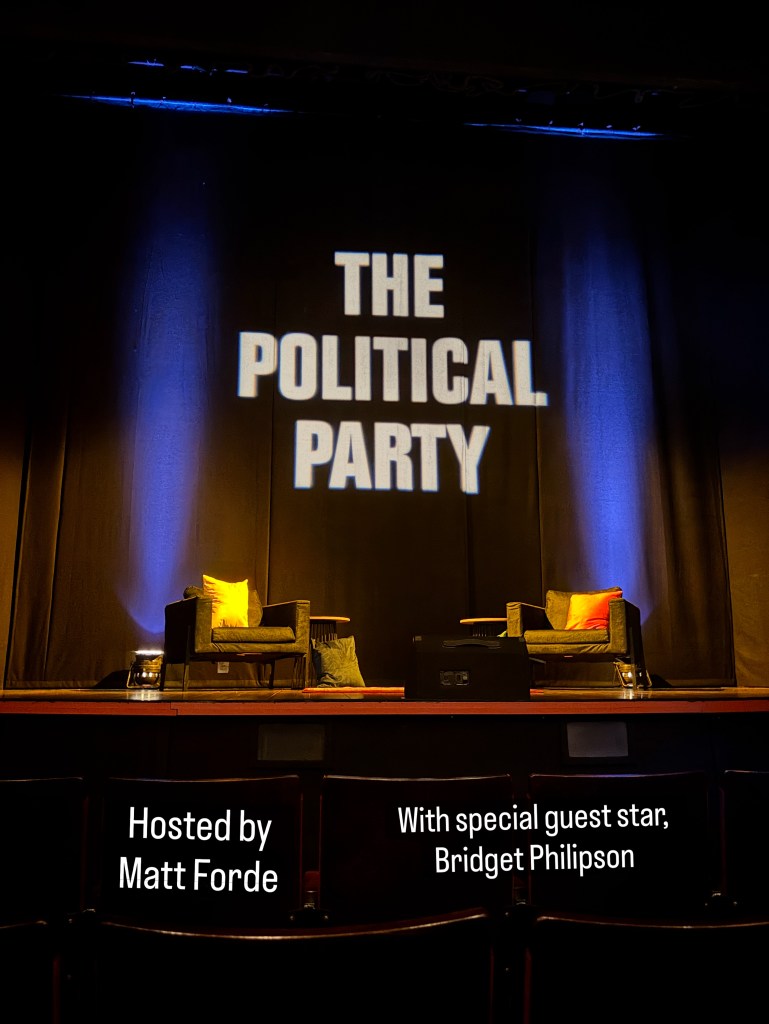
Walking into the Duchess Theatre on a Monday night for a live recording of The Political Party, it was clear from the start that this was a crowd who knew their politics. The foyer buzzed with the latest goings-on in Westminster and the party conferences, the kind of chatter that would sound out of place anywhere else. Inside, younger political enthusiasts — from the stereotypical tie-wearing student politician to the more covert political nerds — were dotted among older fans who had followed Matt Forde for years. The mood was friendly and a little conspiratorial, part comedy gig, part political reunion. About half the audience had been before, laughing knowingly at the show’s long-running jokes, especially Forde’s unabashed love of Tony Blair.
Before the interview began, Forde spent about twenty minutes performing stand-up. Hearing his impressions on the podcast is always a delight — the timing, the tone, the way he moves effortlessly between characters. Seeing him do it live, though, adds an extra spark. He throws himself into each figure with just enough movement to make the caricature come alive: the unfiltered bluntness of Lee Anderson, the fiery confidence of Angela Rayner, the cautious hesitancy of Keir Starmer. He’s a master of the craft, and the joy he takes in it is infectious. It’s like watching a one-man sketch show of recent political history.
After a short intermission, Forde begins his interview. I’ve always appreciated how Forde treats his guests with warmth, humour, and genuine curiosity no matter their political persuasion. That evening he was speaking with Education Secretary and contender for Deputy Leadership of the Labour Party, Bridget Philipson. Like many of his interviewees, she seemed to relax into the atmosphere Forde creates. He makes it feel like a space where politicians can sound human and let their guard down, even though the risk of a headline is never far away (when Angela Rayner appeared on the podcast, for instance, her story about Venom — a now notorious vodka-based cocktail said to feature at her parties — was gleefully picked up by the press).
Still, Forde’s tone encourages openness rather than caution. Many politicians cling to a carefully maintained guise of professionalism that leaves them sounding wooden and dull. Fortunately, Forde has a knack for coaxing them to show a little more personality without steering them into dangerous territory. Chancellor Rachel Reeves offered a good example of that. When she appeared on the podcast, she told a story about a hairdressing disaster that happened just before her first Budget speech — the sort of small, self-deprecating moment that makes someone instantly more relatable.
Of course, Forde’s easy charm can be frustrating at times. Occasionally you want him to press harder or push back more strongly against politicians he surely disagrees with. Even so, there are plenty of places where politicians are grilled to the point of charring, and depressingly few where interviewers allow politicians to sound like themselves. In an age of rising political violence and deepening polarisation, it matters that someone is still trying to humanise the people at the centre of public life. Forde’s style rests on the idea that empathy isn’t a soft alternative to scrutiny but the foundation on which any serious political discussion depends.
His interview technique feels out of step with much of our political culture today. His tone isn’t cynical or performatively outraged; it’s good-humoured, curious, and genuinely engaged with his guests. At a time when public life can feel like a constant shouting match online, that kind of generosity feels almost radical.
It’s easy to sneer at friendliness in political interviewing, to assume that warmth means a lack of rigour. But empathy can reveal things that confrontation cannot. By making his guests comfortable, Forde often gets closer to honesty than most broadcasters. He isn’t trying to catch them out; he’s trying to draw them out. That difference matters. You don’t leave his shows with major policy revelations, but you do come away with a clearer sense of who these people are — their humour, their nerves, their contradictions. It’s politics with its guard down.
I think interview podcasts like The Rest Is Politics: Leading owe a lot to Forde’s template. His show proved there was an appetite for long-form political interviews before big audio production companies like Goalhanger recognised the opportunity. In some ways, Campbell and Stewart can afford to probe more deeply and be a little more forceful in pushing back against their guests. With a vast following, most politicians accept their tough questioning as a small price to pay for access to their enormous platform. Yet there are plenty of Conservative MPs who decline invitations to go on the show. Campbell has spoken previously about how he’s heard the Conservative Shadow Cabinet have been told to decline interview requests from the programme, presumably fearing the kind of exposure that comes with being questioned outside the party’s usual media comfort zones.
Meanwhile, Forde, operating on a smaller platform, has managed to secure a remarkably broad range of guests. Through a mix of charm, humour, and an unspoken assurance that most politicians will leave his stage appearing more relatable than when they arrived, he’s persuaded plenty of Conservatives to take part. Even their leader, Kemi Badenoch, has done the show — a notable absence from The Rest Is Politics’ star-studded Leading guest line-up thats featured most of the key players in British Politics. His geniality undoubtedly helps attract guests who might otherwise say no. In a media landscape driven by outrage and algorithms, persuading politicians to show up and be gently disarmed by humour is no small thing.
There will always be a need for hard-edged political interviews that challenge, confront, and expose. But Forde offers something that’s just as valuable for the health of political discourse. His conversations create space for civility, humour, and genuine curiosity — qualities that too often disappear from modern debate. In reminding us that politics is ultimately about people rather than factions, he helps to restore a sense of empathy to public life. It’s a modest contribution, perhaps, but one that feels increasingly essential. I hope I’ll have the good fortune to attend more of his live recordings in future.
 Josh Wright
Leave a comment